Nairobi borehole costs at a glance (2026)
Nairobi has good water underground. The mistake most buyers make is treating it like a county where you punch a shallow hole and walk away. In 2026, a borehole that will actually serve your building for 20 years costs more upfront — because it must go deeper and, for commercial demand, bigger.
| Project profile | Depth | Build | Est. total (2026) |
|---|---|---|---|
| Shallow (avoid in dense Nairobi) | 80m | 8″ / 6″ PVC | ~KES 1,273,000 |
| Residential — serious spec | 200m | 8″ / 6″ steel | ~KES 2,085,000 |
| High-rise / stressed aquifer | 300m | 8″ / 6″ steel + commercial pump | ~KES 3,035,000–3,435,000 |
| Commercial water-selling | 250m | 10″ / 8″ steel | ~KES 3,210,000–4,210,000 |
The borehole did not fail because Nairobi has no water. It failed because WRA requires 100 metres between boreholes — yet in dense estates holes sit 30 metres apart, all draining the same shallow aquifer. Kisima surveys your plot, recommends the right depth, and drills once — correctly.
Nairobi borehole cost calculator
Pre-set to Nairobi County (180–250m typical). Adjust depth, casing, and pump — get an instant itemized total.
Nairobi's aquifers — Athi Series, Ngong volcanic ash, and stacked water zones
Nairobi's subsurface is not a single water layer at 60 metres. It is a stack of aquifers formed by millions of years of volcanic activity from the Ngong Hills and the broader Nairobi Volcanic Suite, interbedded with sediments of the Athi Series.
Rainfall on the Ngong Hills and southern highlands recharges these formations. Water moves through volcanic ash beds, fractured tuff, and permeable horizons in the Athi Series — which is why a properly sited Nairobi borehole can deliver reliable flow year-round.
Upper zone — can collapse if uncased. Surface contamination risk. Where many cheap boreholes stop too soon.
First water strike many drillers target. Over-utilized in Eastleigh, Embakasi, and dense apartment corridors. Yields decline fast.
More stable production horizons. WRA-aligned surveys increasingly target this band as minimum in urban Nairobi.
Harder drilling but more reliable long-term yield in stressed neighbourhoods. Donholm commercial borehole landed here.
Taps aquifers below the shallow over-pumped zone when the hydrogeological report justifies it. Not every plot needs 300m — but dense, over-drilled areas often do.
A hydrogeological survey maps which of these zones your plot can realistically reach — and at what depth you should set screens, casing, and pump. That is why Kisima never recommends drilling purely on a neighbour's depth guess.
Over-utilization — too close, too shallow, too many holes
Nairobi's groundwater crisis is not a lack of aquifers. It is a spacing and depth problem. The Water Resources Authority (WRA) requires a minimum of 100 metres between boreholes — measured from one drill point to the next — so that neighbouring holes do not pull from the same aquifer zone and drain each other dry.
In dense Nairobi estates, that rule is routinely ignored. What happens on the ground is the opposite of what WRA expects.
| What WRA requires | What happens in Nairobi |
|---|---|
| ≥100 metres between boreholes | Holes drilled <30 metres apart in Eastleigh, Embakasi & dense apartment rows |
| Survey-led siting with neighbour borehole inventory | Drill point chosen by copying the next building's depth |
| Depth justified by hydrogeology in the survey report | Many holes stop at 60–80m to save money on per-metre cost |
| Test pumping before equipping | Pump bought from a catalogue without yield proof |
100m spacing ignored
WRA's 100-metre minimum separation exists to prevent borehole interference. Nairobi blocks routinely have holes 30m apart.
Drilled too shallow
On top of bad spacing, many Nairobi holes stop at 60–80m — all tapping the same shallow, over-stressed lens.
Water table drops
Clustered shallow holes drain the aquifer faster than rainfall recharges it. Pumps cavitate, yields collapse, owners blame the driller.
Repeat drilling cycle
Failed holes get abandoned. New cheap holes get drilled even closer. Aquifer stress worsens. Costs multiply.
Eastleigh is the cautionary tale. Apartment blocks sit side by side with boreholes less than 30 metres apart — when WRA requires at least 100 metres between drill points. Most of those holes are also drilled shallow (60–80m), so every building on the row fights for the same depleted water lens. New buyers see a neighbour's 80m hole and copy both the depth and the spacing mistake. The fix is survey → WRA-compliant siting where possible → deeper target (250–300m) to escape the shallow interference zone.
What borehole drilling actually looks like in Nairobi County
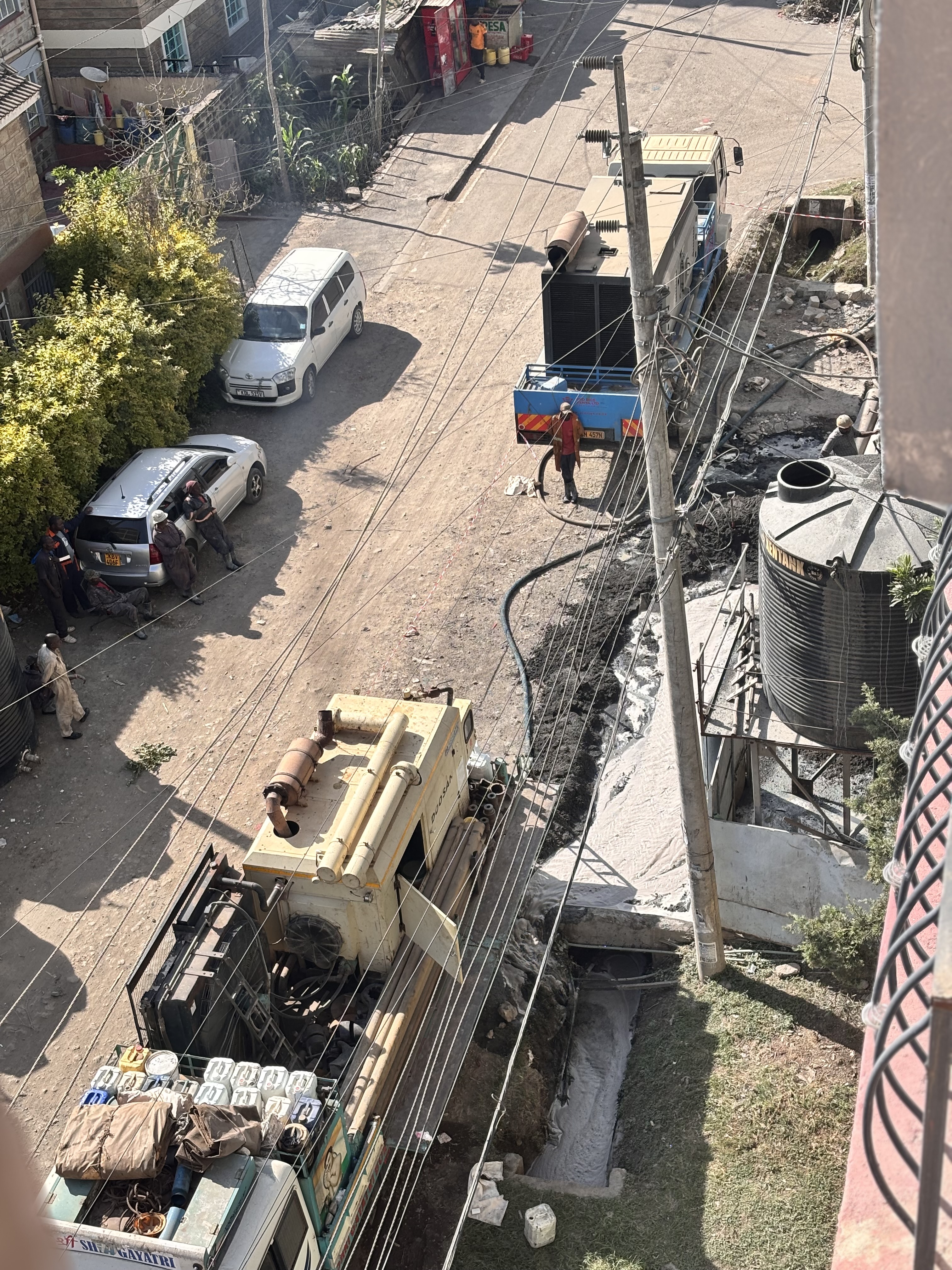
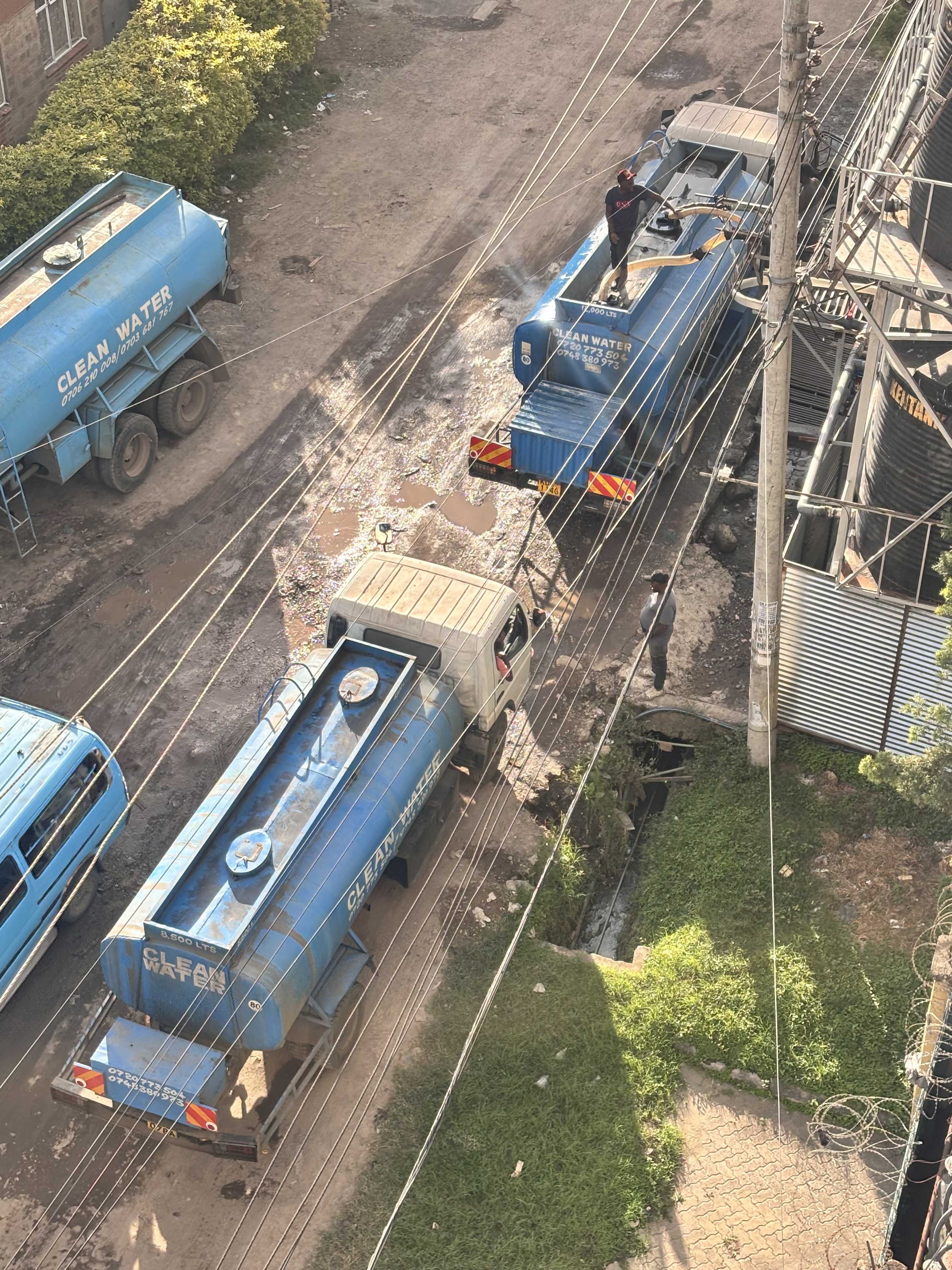
These are real photos from Kisima's Donholm, Embakasi commercial borehole — the same engineering standard we bring to Eastleigh blocks, Kilimani towers, and residential sites across Nairobi. They show why depth, diameter, and proper equipping matter in a city that depends on tanker water when boreholes fail.

When Nairobi boreholes need 250–300 metres
Going deeper is not about spending more for pride. It is how you reach unstressed Athi Series and volcanic production zones beneath the shallow layer everyone else has already over-pumped — when your survey confirms that is where the water is.
- Escape shallow interference — when neighbours are only 30m away (WRA requires 100m), shallow holes at 80m depth compete directly. At 250–300m you tap a deeper, less-stressed zone.
- Utilize stacked aquifers — multiple water-bearing horizons can be screened and sealed properly in one engineered hole.
- Headroom for decline — as clustered shallow holes keep draining the lens, a deep-set pump keeps producing when surface holes run dry.
- WRA-aligned survey — documents every neighbour borehole within the 100m influence zone and justifies your target depth to the sub-basin office.
- Protect your investment — apartments, hotels, and commercial water businesses cannot afford a borehole that fails in year three.
When is 200m enough vs when you need 300m?
| Site type | Recommended depth | Why |
|---|---|---|
| Single dwelling — Karen, Langata, Runda | 180–220m | Better plot spacing — often WRA-compliant; survey may confirm lower depth than dense estates |
| Low-rise apartments | 200–250m | Moderate density, multi-unit demand |
| Eastleigh dense blocks | 250–300m | Boreholes <30m apart (WRA requires 100m) + shallow over-pumping — depth is non-negotiable |
| Kilimani / Westlands towers | 250–300m | High volume + pressure demand across many floors |
| Commercial water-selling | 250–300m | Sustained high yield for tanker loading — see Donholm |
Standard 8″/6″ vs commercial 10″/8″ — what Nairobi buildings actually need
Most Nairobi drillers quote the industry default: drill 8 inches, case 6 inches, install a 4-inch pump. That works for one household. It does not work for a Kilimani tower, a hotel, or a water-selling yard loading tanker trucks daily.
Standard domestic
- Fine for one home or small compound
- Thin gravel-pack annulus
- Limited pump repositioning as water drops
- High risk for commercial volume
Kisima commercial / high-rise
- Room for high-flow 6″ submersible pump
- Thicker gravel pack — cleaner water, longer life
- Pump can be set deeper as levels decline
- Built for towers, hotels & water-selling
10″ drilling premium over standard 8″ hole
At the same depth, a commercial 10″ drilled / 8″ cased build costs more than standard 8″/6″ because of larger DTH hammer bits, slower penetration, and heavier tooling. At 250m in Nairobi, expect roughly:
| Build | 250m structure (indicative) | Premium |
|---|---|---|
| Standard 8″ drill · 6″ steel casing | ~KES 1,665,000 | — |
| Commercial 10″ drill · 8″ steel casing | ~KES 1,815,000–2,015,000 | +KES 150,000–350,000 |
Quoted as a fixed package after survey. Donholm commercial borehole used the 10″/8″ spec at 250m.
Kilimani, Westlands & Nairobi towers — water volume changes the engineering
A Kilimani high-rise is not a borehole problem — it is a water supply engineering problem. Fifty to two hundred households, rooftop tanks, commercial kitchens, and sometimes irrigation on podium levels can demand 50,000–200,000+ litres per day.
That requires:
- Survey-confirmed depth — typically 250–300m in dense zones; your report sets the exact target
- 10″/8″ build for high sustained yield and a 6″ commercial pump
- Test pumping before equipping — prove 10–20 m³/hr, don't assume it
- Storage + pressure system — elevated tanks or boosters sized for peak hour demand
Kisima designs boreholes as the source in a complete water system — not an isolated hole with a pump thrown in.
Nairobi borehole drilling rates — itemized 2026
Every line item Kisima publishes for Nairobi County. No hidden bundles.
| Item | Rate | Notes |
|---|---|---|
| Drilling | KES 3,800 / metre | Rotary / DTH through soil, ash, tuff & rock |
| PVC casing | KES 2,000 / metre | Domestic — limited use in deep Nairobi urban holes |
| Steel casing | KES 2,400 / metre | Recommended for Nairobi depth & collapsing ash zones |
| Gravel pack | KES 300 / metre | Screen zone filtration |
| Rig mobilization | KES 40,000 | Nairobi County standard |
| Hydrogeological survey | KES 35,000 | WRA-standard report — mandatory first step |
| WRA permits package | KES 125,000 | Drilling authorization (see WRA guide) |
| Test pumping | KES 85,000 | Proves yield before pump purchase |
| 10″ drill premium (commercial) | +KES 150,000–350,000 | At same depth vs standard 8″ hole — larger bits, slower ROP |
| Structure total per metre (steel) | KES 6,500 / m | 3,800 + 2,400 + 300 — plus one-off mobilization |
Use the Nairobi calculator above for instant totals, or see our full Kenya cost breakdown.
Four Nairobi cost scenarios — what you actually pay
Real arithmetic from Kisima's 2026 published rates. Pump costs vary by flow rate — ranges shown where applicable.
Shallow 80m · 8″/6″ PVC
≈ KES 1,273,000
- Drilling 80mKES 304,000
- PVC casingKES 160,000
- Gravel + mob.KES 64,000
- Survey + permits + testKES 245,000
- Electric pumpKES 500,000
Looks affordable. Sits in a cluster of shallow holes often <30m apart — when WRA requires 100m spacing. High failure risk in Eastleigh, Embakasi & dense corridors.
200m · 8″/6″ steel
≈ KES 2,085,000
- Structure 200m steelKES 1,340,000
- Survey + permits + testKES 245,000
- Electric pumpKES 500,000
Minimum credible spec for a serious Nairobi residential borehole in 2026. Steel casing handles volcanic ash and depth.
300m · 8″/6″ steel + commercial pump
≈ KES 3,035,000–3,435,000
- Structure 300m steelKES 1,990,000
- Survey + permits + testKES 245,000
- Commercial 6″ pumpKES 800K–1.2M
Taps deep Athi Series zones below shallow over-pumping. Sized for 10–15 m³/hr and multi-floor storage feed.
250m · 10″/8″ steel
≈ KES 3,210,000–4,210,000
- Structure 250m steelKES 1,665,000
- Survey + permits + testKES 245,000
- 10″ drill premium (est.)+KES 150K–350K
- 6″ commercial pump + panelKES 1.0M–1.5M
- Storage / pipework (opt.)KES 300K–800K
10″/8″ adds ~KES 150K–350K over standard 8″/6″ at the same depth. Fixed commercial package quoted after survey. Proven at Donholm.
Donholm, Nairobi — 250m commercial borehole loading 10 trucks a day
This is not theory. Kisima drilled an investor-grade commercial borehole in Donholm, Embakasi, Nairobi County — deliberately oversized and deep because shallow aquifers nearby were already stressed by holes drilled far closer than WRA's 100-metre spacing rule allows.
Build spec: 10-inch open hole · 8-inch steel casing · 250 metres · sustained 18 m³/hr · loads 10+ water tankers daily at 10,000 litres each.
Why 250m when shallow holes existed? Because Nairobi's shallow aquifers are over-pumped and illegally clustered. The survey identified deeper Athi Series and Nairobi Trachyte zones — that is where the 18 m³/hr yield came from.
Read the full Donholm engineering case study↑ See Donholm field photos — drilling, headworks, and tanker loading.
Where we drill in Nairobi County — depth guide by area
Eastleigh
250–300m · 10″/8″ if commercialExtreme shallow over-pumping. Boreholes <30m apart — WRA requires 100m minimum spacing. Survey mandatory.
Kilimani & Hurlingham
250–300m · high volumeHigh-rise water demand. Deep steel casing + oversized diameter for towers and hotels.
Donholm & Embakasi
250m · commercial 10″/8″Dense estates, water-selling opportunity. Donholm 18 m³/hr project is the local proof.
Karen, Langata & Runda
180–220m · 8″/6″ steelLarger plots — spacing often closer to WRA's 100m rule. Survey still mandatory; depth frequently lower than Eastleigh or Kilimani.
Westlands & Parklands
250–300m · mixed commercialTowers plus commercial kitchens. Deep production + storage engineering.
Runda & Muthaiga
200–250m · steelDeep trachyte formations. Established residential corridor — survey-led depth, often better neighbour spacing than inner estates.
Industrial Area
200–280m · high flowFactory and commercial demand. Oversized build if sustained high yield required.
Ruiru & Kamulu corridor
150–200mShallower than core Nairobi city — still survey-led. Different stress profile.
What to expect — Nairobi borehole timeline
- 1. Hydrogeological survey — KES 35,000. Maps Athi Series targets, depth, and WRA coordinates.
- 2. WRA permit — KES 125,000. Legal authorization before the rig mobilizes.
- 3. Drilling — 5–8 days at 250–300m through volcanic ash, tuff, and trachyte.
- 4. Casing, gravel pack & grouting — steel through collapsing upper zones.
- 5. Test pumping — KES 85,000. Certified yield before you buy any pump.
- 6. Equipping — pump, panel, solar or grid — sized from test data only.
- 7. Handover — caretaker training, documentation, abstraction permit guidance.
Nairobi borehole FAQ
How much does a borehole cost in Nairobi in 2026?
How deep should a borehole be in Nairobi?
Why are Eastleigh boreholes failing?
How far apart should boreholes be in Nairobi?
What is the cost per metre for drilling in Nairobi?
When do I need 10-inch drilling with 8-inch casing?
Does Kisima drill in all Nairobi neighbourhoods?
Get a Nairobi borehole quote — survey first, drill right
Tell us your Nairobi neighbourhood, building type, and water demand. We will recommend depth, diameter, and a transparent itemized quote — the same engineering logic behind our Donholm commercial borehole.